“It’s all your bloody fault, isn’t it?” Nik Cohn Speaks with New York Magazine about the Genesis of 'Saturday Night Fever'
© Pascal Lemaître
Nik Cohn Has a Few Regrets
The journalist who wrote the piece that inspired Saturday Night Fever is sorry he made it all up — and is still making art.Two career-spanning essay collections, from Nik Cohn and Jerry Stahl, revel in life’s margins and recapture auras past.
By Jack Denton
First published in New York Magazine on Nov 11, 2026
Nik Cohn is holding his index finger to the sky. “This finger could be gilded,” he says. The writer has never learned to type with more than one digit. “I’m pounding away. It’s all very physical and calibrated exactly to the speed of my words as they come.”
The 80-year-old Cohn sits in an easy chair with his walker nearby, on a brilliant late October morning in the Village, where he is staying with friends while in town from his home upstate. His wife, the children’s-book author Michaela Muntean, flits in and out of the living room, offering him a Claritin to alleviate her concern that he’s sounding “a bit snotty.”
When Cohn was an 18-year-old high-school dropout and proto-punk from Northern Ireland, he’d moved to London to work in a department store and hang out with musicians. One weekend, he visited a friend — whose father happened to be the owner of a prestigious British newspaper — at her parents’ country home. That night, the infamous mods-and-rockers riots occurred in a conflagration of subcultures that mystified the intelligentsia. “So we come down to Sunday-morning breakfast, and he’s there with all his newspapers spread out, asking, ‘What do you make of it? Can you explain why mods, why rockers?’” Cohn says. “And I could, of course. It was right in my sweet spot.”
Cohn was soon writing widely read coverage of youth and working-class culture as these phenomena emerged from the fringes of mainstream attention to complete social dominance over the course of the 1960s. His rock and pop-music criticism punctured boomer pieties before they were canon. He tore into the Beatles’ White Album upon arrival and roasted future Nobel Prize in Literature winner Bob Dylan’s “mind-boggling[ly] awful” and “sophomoric” lyrics. His work of this period reached its explosive apotheosis with 1969’s Awopbopaloobop Alopbamboom, still considered a seminal book of early rock writing for its vivid evocation of pop’s ephemerality and excess.
But more than any particularities of the music he’d been writing about, Cohn was interested in street culture. This was what drew him to the burgeoning disco scene among outer-borough Italians he portrayed in his 1975 New York Magazine story “Tribal Rites of the New Saturday Night,” which was adapted into the John Travolta–starring Saturday Night Fever. The film, one of the most popular of the 1970s, helped spread disco to the mainstream. And the Bee Gees’ Barry Gibb — whose “Stayin’ Alive” might be disco’s most famous song — told Cohn, “It’s all your bloody fault, isn’t it?”
Unfortunately, Cohn’s big story was almost entirely made up, something he admitted after two decades of guilt. But not before he fell further into self-destruction, including a heroin addiction that culminated in a 1983 FBI arrest for drug trafficking (later reduced to a small possession charge).
After a fallow period, he reemerged with some of his best writing, leaning into reporting on people unanointed by society’s insiders. For 1993’s The Heart of the World, he spent four years walking Broadway from the Battery to Yonkers, documenting lovable rogues, dreamers, and singular ne’er-do-wells. Subsequent books like Yes We Have No and Triksta took a similar approach to a post-Thatcher England and his adopted home of New Orleans, where, improbably, he spent a misbegotten period as an “A&R man” in the flourishing local hip-hop scene. His latest book, Corner Boy: Loiterings New and Old, published in October, collects and refurbishes writing from across all these chapters and beyond, pairing them with new, dreamlike dispatches from Cohn’s memory bank.
Cohn has struggled with illness for years, including with an apparent case of Parkinson’s during the last six. When we meet, he is still processing some difficult, though not yet fully confirmed, news about his health. Undeterred, he’s now composing by dictation as he races against his body to complete the various writing projects he’s still pursuing. “I can’t do much else,” he says. “But for the moment I can speak and I can think and I can write.”
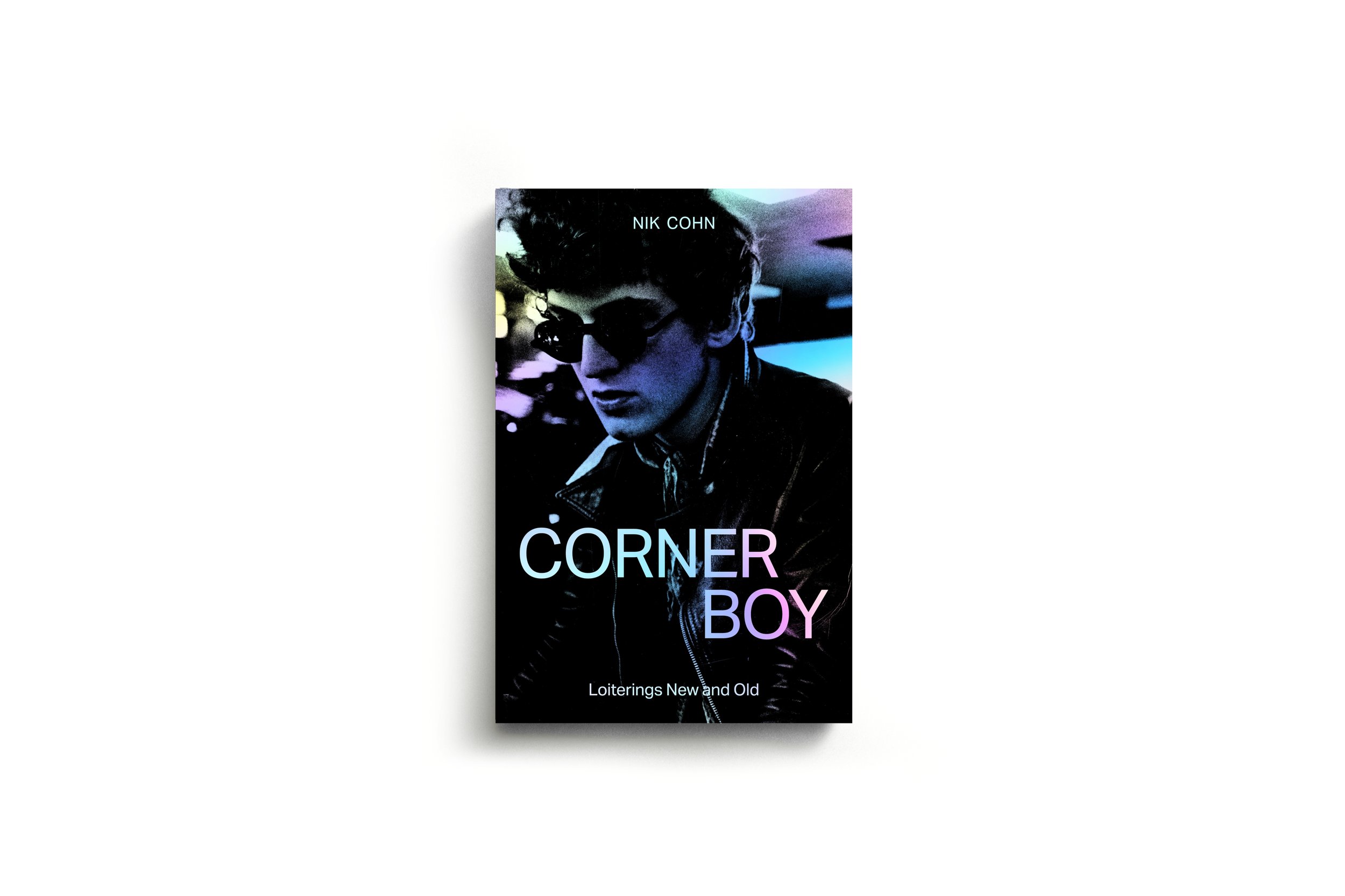
“The best writer about pop music . . . an inspiration.” —Jarvis Cocker, BBC Radio 6 Music
The definitive, lavishly illustrated collection of music writing, memoir, and reportage from the redoubtable Nik Cohn.
Release: Oct 6, 2026
Hardcover ISBN: 9798988670148
392 pages
UK release: Nov 5, 2026 • UK Price: £25
When you were 18, editors at prestigious papers started asking you to write for them because the Beatles had blown up and they sensed that “the culture was shifting under their feet.” They needed a kid to explain it for them. Was it terrifying to be writing in public so young?
Once I started to write, they wanted my voice and I didn’t have time to be scared. I was very pragmatic: “I’ll fit that in between the assignment for Queen magazine.” I wasn’t confident in myself, but I was confident in my opinions. If I said that the Rolling Stones were better than the Beatles, that was because the Rolling Stones were better than the Beatles. I didn’t doubt that, but perhaps I should have. Right or wrong didn’t bother me. It just seemed to be unfolding in real time.
Did you feel like you were documenting momentous historical changes at the time?
I did. It was inescapable if you were in London from 1962 onward. The war really ended in 1962. There’d been the endless aftermath of the war, the austerity, the rationing, the gray suits, the drabness. Nothing had changed really except a few coffee bars in Soho. And then quite suddenly, it all changed. The Beatles were part of that. The Pill was a part of that. The weather was a part of it. It was a sunny summer and everybody came out from under these rocks and suddenly there was a sense of the possible. And part of that was class. Of course it was delusionary because in fact, the top layer of the class system really just went back behind the pavilion, regrouped, and came out and took control again. But for five years or so, it seemed completely free.
Were you thinking about class then with respect to your writing?
I was. When [the newspaper owner] David Astor asked me what I thought, I definitely put on a working-class accent to apply. It was suddenly a big plus. You didn’t want to look too closely at me. All that mattered for me at that time was first impression.
Pop-music criticism as we know it didn’t really exist yet; you were one of the people inventing it as you went along. Did you have any models for your writing? What did you think you were up to at the time?
I don’t think I was directly influenced by a writer’s style. But I was very influenced by the early New Orleans jazz pianist Jelly Roll Morton’s baroque, circular rhythms, and his autobiography Mister Jelly Roll. I used circular rhythms from early on. I’ve always written to a rhythm in my head. Often a jazz rhythm, even when writing about pop. And so I was very influenced by Elvin Jones.
How did you end up relocating to the United States?
I’d been coming over since ’69 for Awopbop. I was spending more and more time in New York, and London had run out of steam. In the music very much so, and then culturally, the Pop Art thing blew through, it was over, and there wasn’t the same vitality in visual arts, film, across the board. It’d set into a bleak period of long winters, endless railway and garbage strikes. Piles. The three-day week, where the government said, “Okay, we can only afford to pay you three days a week.” It was a grim thing that gave birth to punk. I left the year that punk hit, and when I realized that punk had come out, I thought maybe I’d jumped too quick because that would be my medium. Really, I approached pop as punk. Awopbopaloobop is purely a punk book. So I thought, My people — here they come, and I’m gone.
Your column at New York was called “Low and Outside,” and you grew up with a Jewish last name in Northern Ireland and then as an adult moved to New York and New Orleans. I was wondering if you’ve often felt like an outsider, maybe even sought out the position.
In Derry, I didn’t identify as Jewish until I was forced to, when I got beaten up at a Protestant school by people saying “You crucified our Lord.” I couldn’t really avoid it then. But I didn’t see Jewishness as a religion. My parents weren’t practicing Jews, and I didn’t know any who were, so Jewishness meant just otherness or not belonging. I turned that into a boast and became pleased not to belong. Typical only-child syndrome: I have always struggled to deal with more than one person at a time, so I can’t really run in a gang. I give intense attention to one person. The rest of the world disappears while I’m talking to them. So that was an advantage and disadvantage.
I liked the lone-wolf role. I took the opposite stance instinctively. The received wisdom would be “The Beatles are the band that matters.” They revolutionized pop culture. They are the greatest songwriters since Schubert, etc. That immediately raised alarm signals for me. It just didn’t suit me.
But it also seems that whether you were writing about people making bounce in New Orleans or competitive disco dancers, you were drawn to people and cultural movements that “respectable” society might have failed to recognize as meaningful.
A lot of that was just the people who would talk to me. My making up the story that became Saturday Night Fever was partially spawned by the fact that I arrived at this club and no one would talk to me. I couldn’t connect below the surface. I was approaching it wrong somehow, and I realized in retrospect they didn’t relax with me because I talked to them and revealed myself as being English with no point of connection.
So what I did then when I came back and did The Heart of the World was I wouldn’t inaugurate any conversation. I would go to a bar and just sit there. I would sit on a park bench and just sit. Sooner or later, someone would recognize something in me, and they’d come and tell me more really amazing things. It was a long process doing The Heart of the World — four years really walking seven miles. If you sit tight and really listen, people sense that and they talk. And you then have to respect that — really respect it and not exploit it.
Why did you make up so much of “Tribal Rites of the New Saturday Night?”
Panic. I’d sold it hard. Tu Sweet, the incomparable disco dancer I’d written about, had told me about the whole scene over in Bay Ridge, and I went to New York Magazine’s then–editor-in-chief Clay Felker and sold it hard. He was very dubious about it being in Bay Ridge: “Who cares about Bay Ridge?” And then Milton Glaser had James McMullan do the illustrations, which he did and were obviously a treasure trove. So the magazine had invested a lot of money by that time.
I’d only been in New York for eight months. We didn’t go to 2001 Odyssey the first night in Bay Ridge. We went to another club. Tu Sweet went in confidently onto the dance floor and within ten seconds he was just swarmed and beaten up quite severely. And we were back on the street.
A racist incident?
Yeah. One hundred percent. So we went back to Manhattan and regrouped and then the next week we went out to Bay Ridge again. It was a snowstorm, ice storm, wretched weather. And it was very desolate. There was a sign for “warm beer and lousy food” nearby. The club seemed to be dark, but in the doorway there was this lone figure who was standing there very cool with an attitude and look. Then someone came up out of nowhere and threw up on my pants and shoes. So again straight back to Manhattan. And then I went back a third time, and finally we went inside. Tu Sweet came. But when I went to the bar to talk to people, I just didn’t have the language. I was trying too hard. Somehow I couldn’t connect. So my deadline goes, and in the end I just panicked and extrapolated the guy in the doorway.
So all of the people in the piece — Vincent, Gus, whoever — those were all just fictional characters.
I leaned to a degree on my time with mods in West London and Goldhawk Road. I suppose Vincent would be an extrapolation of a mod called Chris Covill who I’d written about. The mirror and the whole culture. When I read it later, I didn’t like it as a piece at all. It seemed mannered and stylized and obviously wasn’t subtle. “The Faces” — I mean, face was a London term. As lying, it wasn’t particularly impressive.
So much revered New Journalism from that period and earlier — Gay Talese, Joseph Mitchell, many others — was pretty loose with facts, quotes, and composite characters. At the time, did you justify your actions with the idea that this was a somewhat common practice among magazine writers?
There’d been a scandal within a few months of me writing this. Gail Sheehy had written a piece that turned out to be largely fabricated as well, but she and Clay Felker were a couple. So that was swept under the carpet a bit. Tom Wolfe, who claimed that in the end what he wrote always had a factual basis, but his piece “The Noonday Underground” — I was in London at that time, and I never saw anything remotely like it.
But I don’t think I really justified it. I thought it was pretty shabby. I wasn’t proud of myself at that time at any level. So that’s why in the end I wrote about it being largely fictionalized without being under pressure. I wasn’t unmasked. I was just uneasy in myself about it, and I wanted to confront where I’d come from.
Were there any other pieces that you ever made up aspects of?
I’m sure I played fast and loose with quotes — the trick of saying something and the subject says “yes” and you attribute it to them. But I did Yes We Have No with a notebook, two tape recorders in case one failed, and a live assistant with shorthand writing skills. Nobody was going to come out and say I’d made it up.
The big difference was that, after the drug bust, I really came back very changed. Part of that was I suddenly wasn’t interested in writing about the people I’d written about all almost exclusively in my first iteration as a writer: celebrities of a kind, pop stars and so on. And suddenly I lost interest in the masculine point of view to a large degree and began to write more and more about women until really very few men remained in my world. And the other thing was I fell in love with dreamers, people who’d fallen by the wayside and still talk big, maybe. But nothing had happened for them — nothing ever would in terms of world recognition.
You write that the arrest made you want “people to talk to me. I didn’t want to be putting my own perceptions on them; I wanted to know what their perceptions were.” Why did it affect you that way?
I think a lot of it just had to do with heroin, because whatever else it is, heroin is a great leveler. If you’re jonesing, you’re looking to score, you’re not Mr. Saturday Night Fever; you’re just a hungry junkie. It’s really humbling to be a junkie. When I went out with Tu Sweet, I scored before I went out to the club the fatal time. That may be one of the reasons why I couldn’t connect with anyone.
I didn’t spend long behind bars at all — one day. But it’s a shock to the system if you suddenly lose all volition. And the first thing to go is speech. Don’t say a word, but do listen. When I was in the holding pen and a man called Cade came up and sat down and told me that he was dying of AIDS. And afterward it struck me very forcefully that we were all in this desperate position, and he’d come and talked; he poured it out to me. I suppose it showed me a potential in myself that I hadn’t been aware of. He must have sensed an openness that if he started to talk to me, I wouldn’t immediately start to talk about myself as I would have done five years previously.
Some of the pieces in the collection are substantially rewritten from their original form. Why did you choose that approach?
When [the downtown No Wave impresario of ZE Records] Michael Zilkha came to me to do an anthology, I was very pleased to do so. To be honest, the last ten years nobody’s been beating a path to my door, so that was very welcome. But then I looked at the old stuff and I thought, This is boring to just plop it out there. It’s like a historical record. I had this idea of revisiting and remixing, but radically — really thinking about it as you would as a musician. In some pieces it’s probably 40, 50 percent new stuff. What it isn’t is what Dwight Garner objected to. It’s not an attempt to whitewash the past. If I had said something that was stinking, like “the Stones should roll themselves up on their 30th birthday,” it stayed. I didn’t want to hide. What I wanted to do was revivify.
The book is interspersed with bits of an unusual and striking collage of art and photos that I believe has hung on your wall in various forms since you were 18 — notably the year you became a professional writer. I was curious why you chose to include it and what relationship it has to your writing.
That’s Muriel. She’s my feminine side. When I look into the feeling inside of my own brain, there’s a playfulness in Muriel and she’s witchy. She makes connections that I don’t immediately make and then I put it together and I see, Oh yeah, that’s what she’s saying all along. That’s connected to that. So I shut up and get out of her way at that point.
You’re talking about having a feminine alter ego in pictorial form, and I noticed that a number of old pieces in the book treat queerness or transness with a loving sympathy that I imagine wasn’t a given in journalism or elsewhere at the time. Do you see a connection there?
It really came from having a low boredom tolerance. By the time I reached 23 or 24, I realized that most men and the things they talk about are extremely tedious. It started when I had the job in the Army & Navy store. It was mostly women working there. I was 16, and for the first time I listened to ordinary women talking. I was startled by how healthy and interesting it was. Women seemed to have no problem exposing the kind of thing that no man at that time would be willing to own up to. So from that time, I always responded more to women than men. And my closest friends are all women, except for Ben Ratliff [who edited Corner Boy] and Andy Wickham [the famed A&R who signed Joni Mitchell, Van Morrison, and Neil Young], who’s no longer with us. Normally when a woman starts talking to me, I know what she’s talking about somehow. And if men start talking, I don’t.
You’ve been dealing with health issues going back decades. Hepatitis C, then Parkinson’s, now possibly something even more serious. How have your illnesses affected your writing?
When I contracted hep C, that seemed to be a death sentence. Turned out to be not so fast. But I would say it humanized me and made me more responsive to the kind of things I was responding to anyhow. I would like to think that now I have no barriers or prejudgments when somebody comes up and starts talking to me. I hope that’s true, and I think being very ill has helped that.
I don’t have a timetable, but it’s probably months rather than years. I still have two books and a film that I really, really want to do. I’m going to have to write all three of them simultaneously. In terms of time, it’s a big ask.
How are you feeling emotionally about the possibility of being quite sick and having limited time left?
It’s a tough one. I do hate the idea of leaving Michaela and my daughters behind. I hate that. But that is banal and obvious. In general, I imagine this is the case for most people who have a death sentence of any kind, but it feels like unfinished business. I want to know how Trumpism plays out. I probably won’t see it. So there’s a frustration to that. But the main thing is I have had an incredibly full life, and I can’t feel cheated at all. And Corner Boy encapsulates what it’s meant to be alive for me in my time. So if it turns out that all these other plans don’t come to anything, and Corner Boy is the last word, which is obviously very possible, I won’t feel cheated.