“My Beat Was the Off-Beat”: Jerry Stahl Profile in SPIN Magazine
Author and screenwriter Jerry Stahl, as he prepared to release a collection of his work, "Gonzo Neurotic." (Credit: Steve Appleford)
Jerry Stahl: “My Beat Was the Off-Beat”
The ‘Permanent Midnight’ author has a new book out. He talks to SPIN about how far he’d go to get a good story
Written by Steve Appleford
First published in SPIN on Oct 27, 2026
The watermelon is a wholesome surprise from the man in black, not quite what I expected from a visit with author Jerry Stahl. He’d offered me a hardboiled egg, then volunteered to whip something up in the kitchen before slicing the melon. He is a perfect, tattooed host on a quiet street 20 minutes from downtown Los Angeles.
The house is pleasantly cluttered with infernal art and stacks of books, reflecting a lifetime of countercultural obsessions. A dark, noirish skyline by Raymond Pettibon hangs on one wall, and a Diane Arbus photograph of a plump family of nudists hangs on another. At my feet is a tiny rescue dog named London, eyes bulging from his pleading little face, tapping at my leg.
“I’m trying to make this pleasant because I’m used to being at your end,” Stahl says with a smile from further down the dining table. He’s long since moved on to writing books and screenplays, but he made his living as a journalist for many years. “I’m very uncomfortable being on this end, to be honest with you.”
The scene reminds me of my first time at Gene Simmons’s mansion years ago, deep in the canyons of Beverly Hills, when the God of Thunder gave me a delicious ice cream sandwich. Some interviews are like that: good company with a dangerous mind.
We’re here to talk about Stahl’s new book, Gonzo Neurotic: The Best (and Not-So-Best) of Jerry Stahl, a collection of articles, essays, confessions, fiction, and other bits and pieces from the first 40 years of his writing career. He worked as a freelance journalist many of those years, and wrote of immersive encounters at the Miss America Pageant, at a nude smorgasbord for swinging singles, a trip to Marlon Brando’s private island, interviews with David Bowie and Mickey Rourke, his own drug years, and the inexplicable fame that followed his wild, narcotic memoir Permanent Midnight.
“My beat was the off-beat, as they say,” Stahl says.
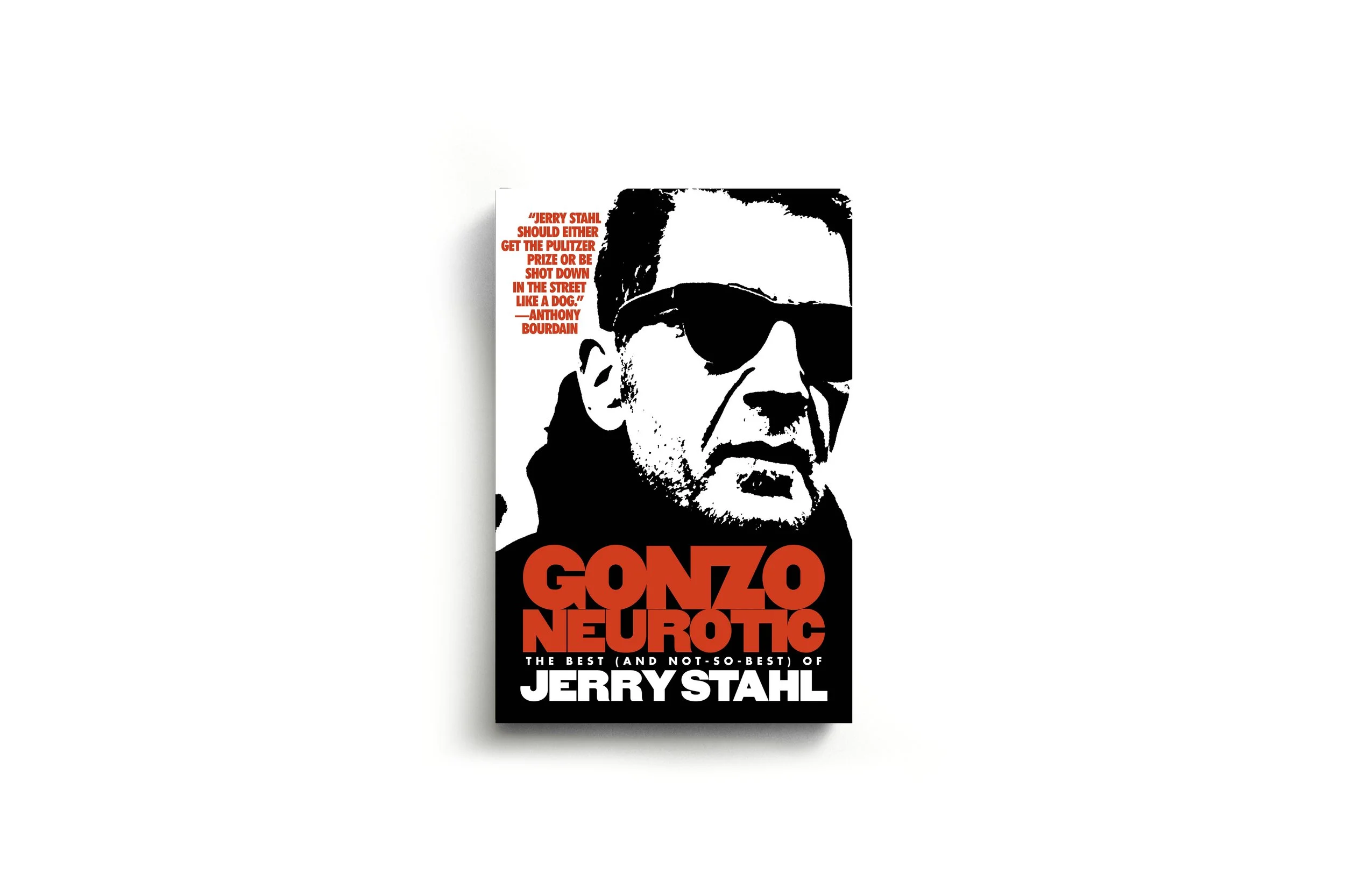
“Jerry Stahl should either get the Pulitzer prize or be shot down in the street like a dog.”
—Anthony Bourdain
“[A] career-spanning collection . . . Stahl is funny, self-aware and very much in on his own ‘professional ex-junkie’ act . . . But he’s a more sober observer than he lets on . . . Stahl is his own vivid comic invention. Life whooshes past him like arrows, and some of those arrows stick in his guts.”
—Dwight Garner, The New York Times Book Review
Fifty years of sex, drugs, show business, and bad behavior from the inimitable laureate of American excess, Jerry Stahl.
Release: Sep 29, 2026
Paperback ISBN: 9798988670186 • 456 pages
UK release: Nov 5, 2026 • UK Price: £14.99
All of it was written with humor and biting prose, in the tradition of his many literary heroes: the Beats, Hubert Selby Jr., Hunter S. Thompson, Tom Wolfe, Nick Tosches, Lester Bangs, and other hardboiled masters of outlaw stories and pulp poetry. Stahl was drawn to their fearlessness and dark sense of humor.
“I don’t flatter myself that I’m on that level, but for me gonzo was a technique of plunging into an uncomfortable situation,” Stahl says. “And then you’re writing as much about your own discomfort as you are the subject of the thing.”
From early on he had that most precious thing an ambitious young writer can have: a voice. The book’s original pieces show the presence of an anxious mind at work, with its brutal flow of biting wordplay and human comedy.
That said, the experience of digging into his boxes of old magazines and newspapers for his vintage pieces was sometimes excruciating. In his introductions, he expresses remorse and horror at the evidence of his early years as a writer, along with certain word choices and expressions scribbled in the ’70s, ’80s, or ’90s that are no longer fit for polite society circa 2026. Some of the longest pieces (of about 10,000 words) are trimmed back to a more manageable length.
The intros are meant, he says, to be painfully amused looks backward, exploring “what an egregious lapse in taste and character any given piece might have been at any given time.”
He wrote for obscure publications but also legit titles like Playboy, Esquire, Detour, California Magazine, Los Angeles Magazine, and more.
Things didn’t always work out. While an astute editor might call on Stahl for his gonzo sensibility, that same editor might be confounded by the freewheeling copy he turned in. Stahl’s adolescent dreams of filling magazine pages with his crazed prose hit the reality that times had changed in the mainstream magazine world.
“That’s how I wanted to write. I remember I finally got a gig with Rolling Stone—one gig—and it was a profile of Jeff Bridges,” he recalls of one 1982 assignment, not included in the book. “I wrote just a wild-ass fuckin’ piece. And that was over. They were just, like, ‘What the fuck is wrong with you? Just do a profile.’”
“It was a more anodyne era then. Everything was People.”
A lot of his best work first appeared in various alternative weeklies in Los Angeles, working for editors who encouraged his wildest, most personal writing. He was a columnist for the Los Angeles Reader and wrote 12,000-word features for LA Weekly. That once-vibrant industry is largely decimated now, a victim of consolidation, bad ownership, and falling ad revenues due to the rise of online platforms. They weren’t his highest-paying gigs, but for a time, they were places of near-total freedom for his outlaw literary impulses.
These days, he satisfies his occasional need for immediacy with a Substack, Jerry Stahl’s Nowheresville, where he weighs in on his cultural and political worries of the moment. (Trump has become a frequent character there.) His magazine days seem mostly behind him, though he insists, “I would serve if called.” His schedule is otherwise full with books and scripts for movies and TV. His next book is a novel, Bad Sex in the Afterlife, to be published in early 2027. Stahl is also at work on a screenplay about young Lou Reed, another heroic cultural reprobate.
Writing for the screen is his most lucrative vocation, but prior to his first break into TV land, he was dedicated to the written word on the page. Becoming an author of books was his dream destination, and he was working toward that in an early career that he describes in the new collection as “my role as pill-popping, joint-puffing, oddball magazine guy.”
That history stretches all the way back to his first published piece at age 21, documenting a visit to Mona’s Gorilla Lounge, a local bisexual bar, for the Santa Cruz Times in 1974. The voice is already present in the words, full of attitude and 21-year-old wisdom on the sexual revolution unfolding then.

Ben Stiller and Stahl attend ‘Jerry Stahl In Conversation With Ben Stiller: Nein, Nein, Nein!’ at The 92nd Street Y, New York City, June 12, 2022. (Credit: Mark Sagliocco/Getty Images)
By 1981, he was on a fully immersive assignment for “Adventures in the Singles Trade,” exploring the far corners of L.A. dating, from intensive New Age counseling to clothing-optional parties with food and dancing for $12 a head. “You’re all naked and everybody’s pubes are at the level of the potato salad,” Stahl recalls now. “The nude singles weekend certainly tested my mettle. That’s a commitment to plunge in. But I was still doing drugs then.”
As a result of that work, he was miraculously recruited as a writer of snappy dialogue for network television, passing through “ALF,” “Thirtysomething,” and “Moonlighting.” By then, heroin and cocaine had taken hold of him, and he was frequently excusing himself from the studio set or office for a fix of “brain tonic,” puncturing an arm and leaving a fresh layer of blood spray on the bathroom walls and ceiling.
In Gonzo Neurotic, he writes about this bleak period in a 1992 magazine piece called “Naked Brunch” (not his title, he insists), which finds our junkie hero working as a panicked writer and barely holding things together for the birth of his first daughter. Soon after, things go off the rails completely, and he blows a dream gig writing for David Lynch’s “Twin Peaks,” turning in an incomprehensible, blood-stained script, then ricocheting back into treatment. The frantic article is the seed that later birthed the complete nightmare tale in the form of Permanent Midnight, the 1995 addiction memoir that changed his life and career, transforming him into an acclaimed author with a following. The 371-page book was then made into a film starring Ben Stiller.
“Until Permanent Midnight, I don’t know that I ever wrote an honest word,” he says. “All I ever wanted was to write books. But the irony is the moment of your greatest triumph is also the moment of your greatest shame, because you’re talking about the most horrific shit. That was always the paradox. People say to me, ‘Oh, man, being a junkie was a great career move.’ I didn’t know it was research at the time, but I guess it was.”
The film was the beginning of a true friendship with Stiller. They’ve worked together on many projects in the years since (not all of them produced), and Stahl was best man at Stiller’s wedding to Christine Taylor in 2000. Stiller even cast Stahl in on-screen cameos in Zoolander and Severance.
“The great thing about working with somebody like him is he makes your writing better,” Stahl says. “Usually, you get notes from people and you just want to jump in front of a subway. But with him, it’s like, ‘Well, this may be tricky and a bit of a pain in the ass …,’ but somehow on the other end you’re so glad you did it.”
Despite the desperate, near-death experiences that he’s written about, Stahl looks fit this afternoon, wearing tinted Ray-Bans, dark-haired with a gray soul patch beneath his lips. In another part of the house with two other dogs is his wife, Zoe Hansen, who released her own memoir this year, Going Down In Gotham, about her adventures in the New York underground.

(Credit: Steve Appleford)
A few steps away is Stahl’s office, a small room lined floor-to-ceiling with books, a copy of Allen Ginsberg’s Howl prominently placed by the door. He does most of his writing in this room and on the patio out back.
For Esquire, he once wrote a short profile of Bowie, especially notable in that it was a rare interview that included a manly hug before it was over. (They’d attended some of the same 12-step meetings in town.) He also spent a memorable time with actor Mickey Rourke, who didn’t seem to sleep and shared, “That’s how I get this look. I stay up all night.”
Stahl adds, “People’s lives, man. And you find out a lot more than you can put in print sometimes.”
Also included in the book are alarming excerpts from I, Fatty, his third published novel, a 2004 fictionalized autobiography of tragic silent film star Fatty Arbuckle. Like the real story of Arbuckle, it describes a life of excess and self-loathing, and the criminal trials that followed the death of an aspiring actress after attending a party he hosted in San Francisco. For a time, Philip Seymour Hoffman was attached to play the broken comedy superstar, and he met a few times with Stahl, sensing some truths in the book about its author.
“He said, ‘This is much more of an honest memoir of you than Permanent Midnight was. You’re just hiding behind a fat guy,’” Stahl says. Hoffman pointed to the shared addictions, shame, and alienation between writer and subject. The actor “was such an otherworldly, bright kind of guy. It’s something that stayed with me.”
For Stahl, his first moment of revelation came at age 13, when he shoplifted a copy of Hubert Selby’s Last Exit to Brooklyn from Kaufmann’s department store in Pittsburgh. The grim novel of addiction, violence, poverty, and urban despair left a mark.
“I was just drawn to it,” he says. “When I read it, it kind of ruined my youth. Childhood was over.”
Later on, they became friends, and Selby was a kind of mentor in brutal lit and dopehead wisdom. Selby already kicked a heroin addiction back in the 1960s while in custody at L.A. County Jail. At one point, Stahl expressed worry that kicking his own drug habit would diminish his creativity. “He laughed in my face,” Stahl recalls. “He said, ‘You don’t know how crazy you are until you’re off of everything,’ which, for better or worse, proved to be true.”
Like generations of artists, writers, and musicians before him, Stahl had been convinced all of his feral adjectives were in the drug, which he now calls “a pretentious, ludicrous kind of amateur attitude.”
“For me, it didn’t make me more creative,” he eventually realized. “It just made the seat more comfortable, you know? It’s like that Burroughs thing: They asked him why he did heroin, and he said, ‘So I can get up in the morning and shave.’”
Stahl left the drug life back in the ’90s, which he credits in part to fatherhood and his two daughters, Stella and Nico. But echoes from that past occasionally show themselves.
“I can’t speak for other people,” he says, “but you’ll be driving down the street and, at a red light, see some guy doing the fentanyl fold—you know, kissing his own kneecaps. It’s like, ‘Oh, that might be good.’ It’s completely insane. I don’t think I’m alone in that.
“I mean, you’re always addicted to something, but some vices are a little less cruel than others.”
As I prepare to leave, Stahl insists that I take another slice of watermelon with me. It’s going to look great in my fridge. In real life, Stahl remains hardboiled and humane.
“Whatever I write, for better or worse, comes out kind of funny. It’s like, the darker the corner, the funnier the scream,” Stahl says. “Choose your cliche and you stick with it, you know?”