Everything You Think You Know about Iran Is Wrong: An Excerpt from 'Minister without Portfolio'
The recent strikes in Iran and the reported death of Ayatollah Ali Khamenei have placed the region at a profound crossroads, lending a harrowing relevance to Iranian author Hooman Majd’s memoir, Minister without Portfolio. The following excerpt revisits a pivotal moment in 2009, when Majd and journalist Ann Curry reported from the center of the Green Revolution in Tehran during the contested election between Mahmoud Ahmadinejad and reformist candidate Mir Hossein Mousavi. Majd’s firsthand account of that upheaval and his insightful analysis of the long-fraught relationship between Iran and the US offer essential context for the current crisis.
Join us on March 11 for a conversation between Hooman Majd and Ann Curry at McNally Jackson Seaport, where they’ll discuss the historical roots of the present conflict and the uncertain path forward for the Middle East, and read on for a glimpse into the briefly hopeful political climate they navigated together.
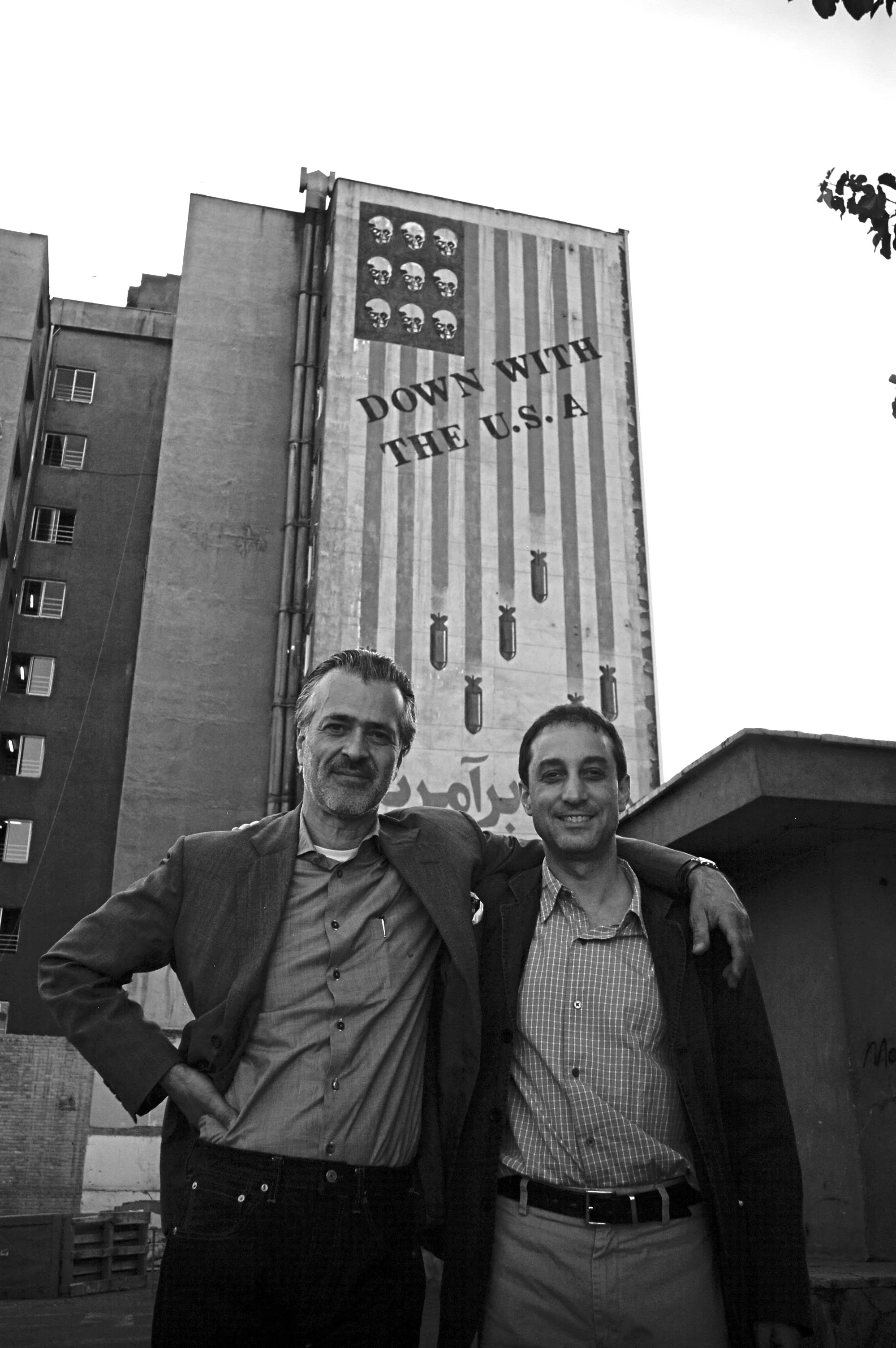
With Richard Greenberg of NBC News, Tehran, 2009
Everything You Think You Know about Iran Is Wrong: An Excerpt from Minister without Portfolio
By Hooman Majd
The following excerpt is from Minister without Portfolio: Memoir of a Reluctant Exile, published by ZE Books in September, 2025.
In 2009, Nisid Hajari, the foreign editor at Newsweek, asked me if I would be interested in a cover story on Iran, in a special issue in anticipation of the presidential election that June as Ahmadinejad vied for a second term. I jumped at the chance. Just before I left for Tehran, an NBC News reporter, Robert Windrem, introduced me to a producer colleague, Richard Greenberg, who had read my book and wanted to go to Iran. I knew Bob Windrem from 2006, when I had consulted for NBC regarding an interview it had secured for Brian Williams with President Ahmadinejad during the U.N. General Assembly. Rich Greenberg and I met at a steakhouse in midtown Manhattan.
Greenberg was looking to produce an Iran special for NBC to be aired on Dateline, anchored by Ann Curry. (Dateline was then still a general-interest program, like 60 Minutes, but not nearly as popular among foreign policy or politics junkies.) He wanted Ann and a crew to spend two or three weeks in Iran and come back with a program that would show Americans what Iran was really like, behind its president’s outrageous comments and belligerent speeches at the U.N. Iran’s nuclear issue, too, was no closer to being resolved than when Khatami had left office four years prior.
Brian Williams, NBC News anchor, interviews Ahmadinejad in New York. Standing with the author is then Iranian ambassador to the U.N. Mohammad Javad Zarif
Rich wanted to know if I’d be willing to go with the network to Iran as a guide and consultant, and I naturally said yes. I suggested that the first step should be for Ann Curry and him to meet with Iran’s ambassador to the U.N., Mohammad Khazaee, who had replaced Zarif and was a compromise choice for Ahmadinejad and Ayatollah Khamenei. Khazaee had been Iran’s representative at the World Bank in Washington, was familiar with the United States and American culture, and could smooth the way for NBC to secure visas and press credentials for the trip. The press officer at Iran’s mission, Mohammad Mohammadi, was sure to be supportive, too. I set up a meeting with the ambassador and Mohammadi, and Ann charmed them both. Before long, we had approvals from Tehran, and plans were made for a trip to begin in mid-May for the presidential campaign season, limited by law to thirty days.
Meanwhile, I left for Tehran in the third week of April and traveled to Isfahan, Yazd, and Qom for Newsweek. Fareed Zakaria, who had recommended me to Nisid Hajari at the magazine, was going to write an article for the issue, and Maziar Bahari, Newsweek’s correspondent in Iran, was assigned to interview former president Khatami. (He told me later that at the Ministry of Culture and Islamic Guidance, where press credentials are issued, he was asked why Newsweek was sending me to write the cover story while he was the Tehran bureau chief. He told them they should ask me why.) Upon return to New York, I hurriedly wrote my piece and submitted it; Nisid and I worked on edits, and I left with the NBC team for Tehran in mid-May, before the June 1 issue of Newsweek hit the stands.
While in Iran for NBC at the end of May, I was emailed the image of the cover and was horrified. The editors could not have picked a less complimentary photo of Ahmadinejad, and with me inside Iran, I worried that I’d be called into the culture ministry soon enough. In fact, the entire issue, including Fareed’s piece, was much kinder overall to Iran than most Western media coverage. I assume the officials at the ministry were too busy with the upcoming election to notice or to care, and I never was called. My story was called “Tehran or Bust,” and I was quite proud of how it turned out, showing a side of Iran most Americans would not ordinarily see, sort of a companion to my book, and complementary to what I thought NBC wanted to accomplish.
Newsweek cover story
Adding the piece to others I had written for major media outlets (Newsweek wasn’t then the shell of itself it is today), I felt my journalism career was well on its way. Later in the summer I wrote for The New Republic about the 2009 election that gave Ahmadinejad another four years in office, which to me seemed if not outright fraudulent, at least extremely suspicious. I had a good time in Iran with Ann and the NBC crew, and I found television work—both being on camera and coming up with stories—to be fascinating and enjoyable. We had plenty of time to witness and document not just the political environment, but the excitement of the youth yearning for what appeared to be change on the horizon. I hoped that television news might be another component in my career as a journalist and author.
It was a fortuitous time for NBC to be in Iran, as the campaigns for the presidential elections were in full swing when Ann Curry arrived for her first-ever trip to the country. The mood, especially among the young, was festive. Mir Hossein Mousavi, the main challenger to Ahmadinejad, was a reformist who, unusually and in a first for Iran, campaigned with his wife. More important, he sought the support of Khatami, who not only endorsed him but joined him at rallies, one of which, in an overpacked Tehran stadium, we attended with the NBC camera crew. Campaign posters even had Mousavi and Khatami pictured side by side, in an unsubtle hint to voters that a vote for Mousavi was a vote for a return to the Khatami era—one of relative openness, more liberal social attitudes, and better relations with the West. The youth, and especially in the urban areas, were excited.
Ann Curry interviewing the author in the gardens of the Abassi Hotel in Isfahan, May 2009
We traveled to Isfahan and shot footage there, to the mountains north of Tehran, and all around the city. Ann interviewed Khatami, and though Mousavi was too busy, Mousavi’s wife, Zahra Rahnavard, was willing to sit down with Ann at their campaign offices. It remains the only interview she has ever given to Western media, and as of writing, she has remained under strict house arrest with her husband since 2011. The through line in all the interviews at the time was “hope”; whether by politicians, activists, or young people on the streets and at rallies. The excitement Iranians felt for the future, at least in the urban areas, especially impressed not just Ann, for whom Iran was new, but me as well. That that hope was soon dashed, rather violently, was distressing to me and countless of my fellow Iranians, inside and outside Iran.
Hooman Majd is an author and writer based in New York, and a contributor at NBC News. He has written for The New Yorker, The New York Times, TIME, Newsweek, Financial Times, and Interview, among others. Majd is the author of the New York Times bestseller The Ayatollah Begs to Differ (Doubleday, 2008), The Ayatollahs’ Democracy (Norton, 2010), The Ministry of Guidance Invites You to Not Stay (Doubleday, 2013). Majd has appeared on numerous television and radio shows, including Real Time with Bill Maher, The Daily Show with Jon Stewart, Charlie Rose, NBC News, and many others, and on numerous NPR programs. His memoir Minister without Portfolio was published by ZE Books in 2025.

From the author of The Ayatollah Begs to Differ comes a globe-spanning memoir of identity, exile, and reinvention.
Release: Sep 30, 2025
Hardcover ISBN: 9798988670063 • 320 pages
UK release: Nov 6, 2025 • UK Price: £25